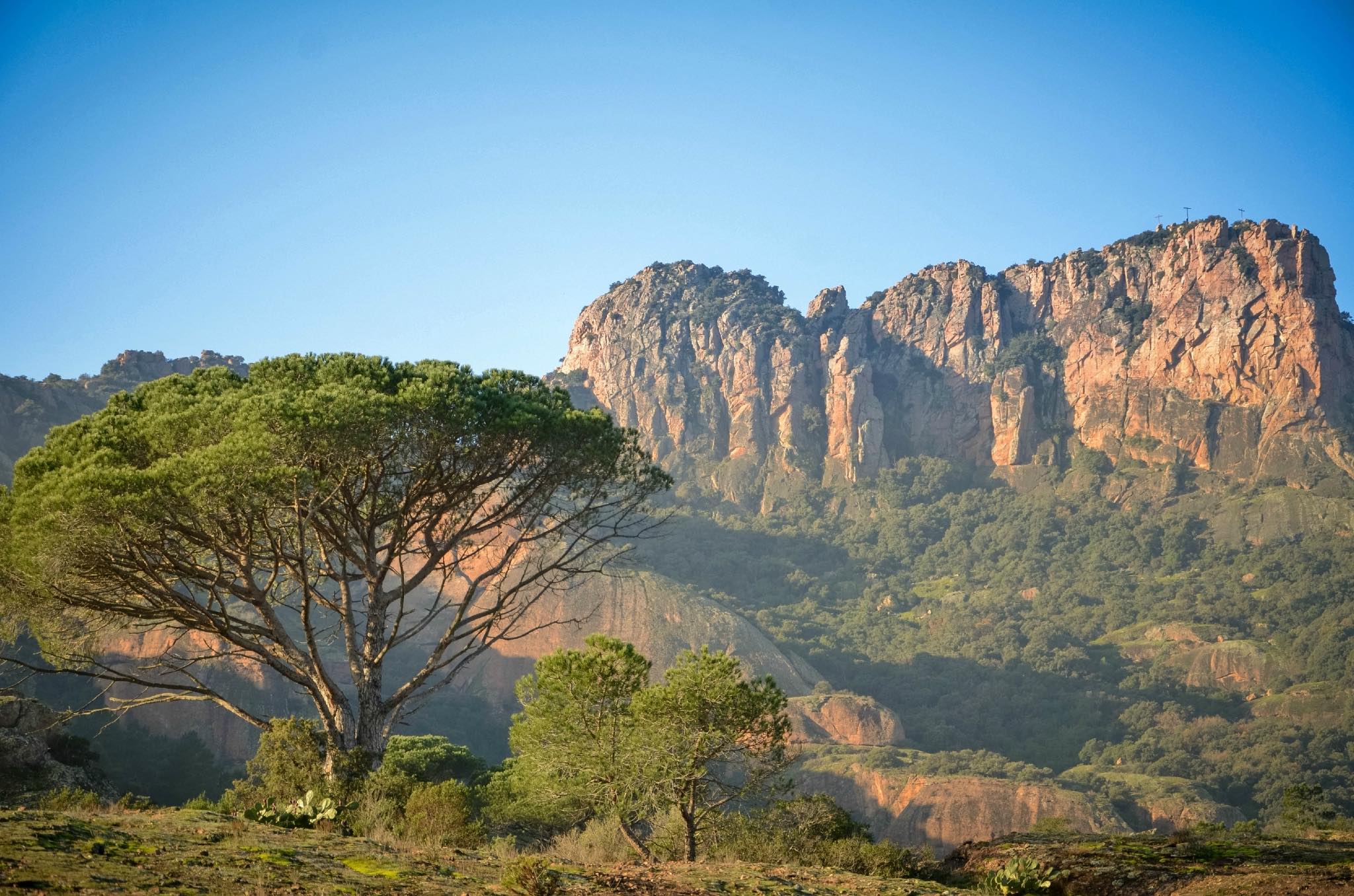
The Rocher de Roquebrune is a mass of red sandstone and conglomerate rising 373 metres, standing alone in the middle of the Argens plain between Fréjus and Le Muy. A marked path leads to the summit and to Bernar Venet's three crosses in two hours there and back. The site is freely accessible all year round.
A mountain apart
You see it from everywhere, and it looks like nothing else in the landscape. Where the Estérel forms a massif and the Maures a range, the Rocher de Roquebrune stands alone: a dark red block set down on the plain, its flanks cut into vertical faces that catch fire in the evening light. Geologists read in it the remains of a delta 250 million years old, compressed into sandstone and conglomerate, then stripped bare by erosion. The walker simply sees a natural fortress.
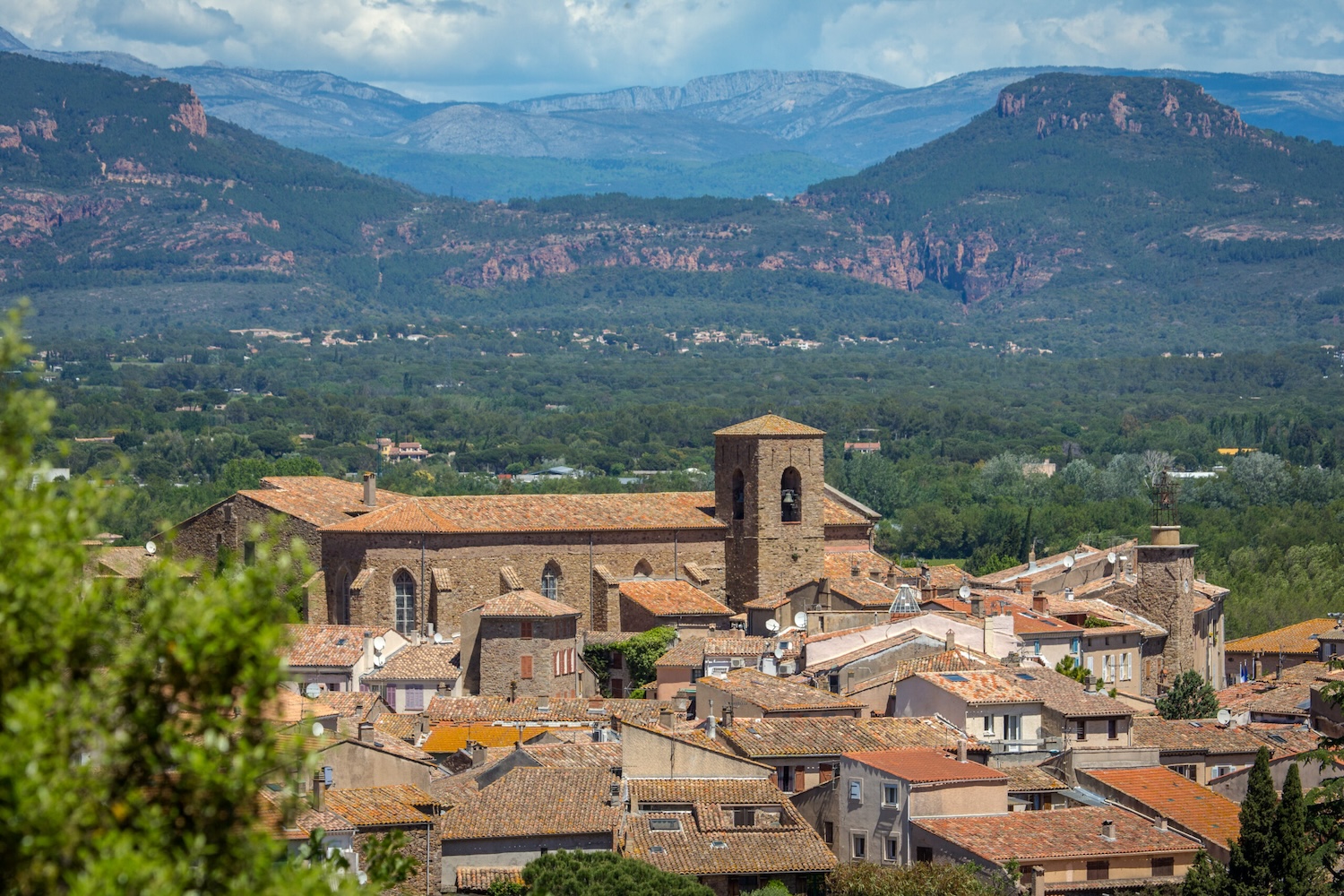
The village settled at its foot, and climbing it you understand why hermits chose the place: the rock still bears traces of a hermitage, a chapel and a devotional path that the modern trail partly follows.
The Three Crosses path
The classic route starts from the car park at the foot of the rock, on the road climbing from the village towards La Bouverie. The path is marked, steep in places, over sandstone that grips well when dry and turns soapy after rain. You need proper shoes, water, and a hat: the south face has almost no shade.
The summit announces itself with the three crosses. They are sculptures by the Var artist Bernar Venet, installed in 1991: three lines of steel in different colours planted on the ridge, answering the nickname of Mount Golgotha the rock has carried for centuries. You can see them from the motorway, and up there you understand that they mark a full 360-degree viewpoint: the gulf of Fréjus and the sea, the red Estérel, the dark Maures, the vineyards stretching to Les Arcs, and on a clear day the Alps.
Allow two hours there and back at a good pace, two and a half taking your time. The climb is around 300 metres.
Time of day and season
Set off early. In summer you want to be at the summit before nine, both for the heat and for the light, which rakes across the red faces at sunrise and turns them almost orange. Evening does the opposite from the plain below: that is the moment to look at the rock, not to climb it.
The rock can be climbed all year round, with no seasonal restriction. In high summer the difficulty is not access but heat: the south face has no shade and the sandstone holds the day's sun. Leave at dawn, be back down before ten, and carry more water than you think you need.
Spring and autumn are the rock's real seasons. In April the maquis is in flower; in October the light stays low all day.
Two detours
At the foot of the north face, the chapel of Notre-Dame de la Roquette, long ruined and now partly restored, was a medieval place of pilgrimage and is reached by a path from the village. The hermitage of Saint-Michel, tucked higher into the rocks, is reached by a variant of the main path: a fitted-out cave, a few walls, and a view that repays the effort.
On the way back, the village of Roquebrune-sur-Argens is five minutes by car, for a coffee under the arcades or an ice cream by the Aréna lake.
Practical information
Where
Car park at the foot of the rock, route de la Bouverie, Roquebrune-sur-Argens
Getting there
15 min from Puget-sur-Argens · 20 min from Fréjus · 30 min from Draguignan
How long
2 to 2 hrs 30 there and back to the Three Crosses
Ascent
Around 300 m
Difficulty
Moderate, steep rocky path, no technical sections
Children
From about 8, if used to walking
Dogs
Allowed, on a lead
Water, shade
No water point, very little shade on the south face
Best season
April-May and October · at first light in summer
Access
Free, all year round, no seasonal closure
Frequently asked questions
Two hours there and back to the Three Crosses from the car park at the foot of the rock, two and a half taking your time. The ascent is around 300 metres.
This guide is part of the address book of a private estate in Puget-sur-Argens, 15 minutes away, available for weddings and family stays. It is not open to visitors.