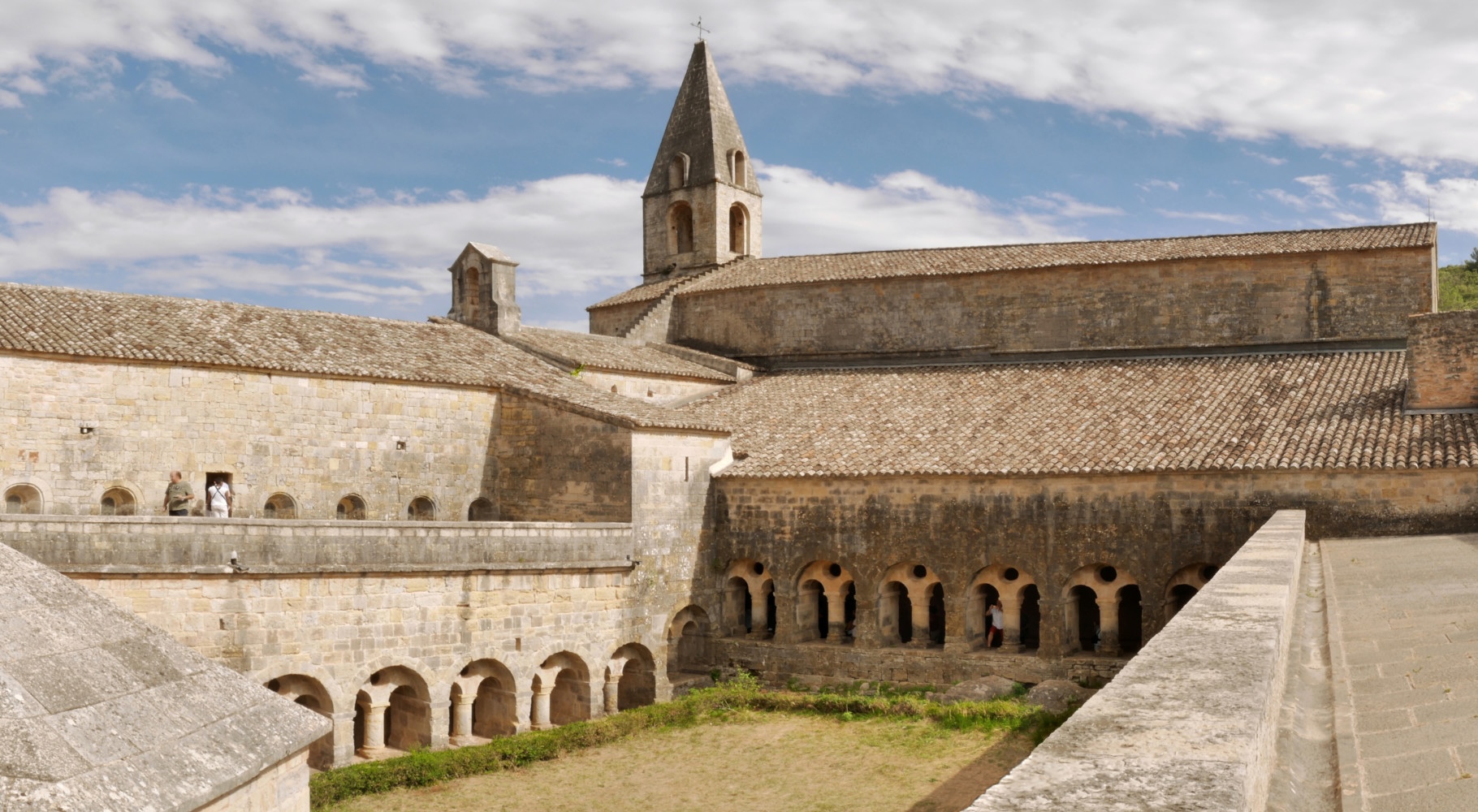
Le Thoronet Abbey is a twelfth-century Cistercian abbey, the oldest of the three Provençal sisters along with Sénanque and Silvacane. Built without ornament, in bare limestone, it is famous for its proportions and its acoustics, which bring regular programmes of Gregorian chant. Allow an hour for the visit.
Austerity as a principle
The twelfth-century Cistercians had a rule: nothing that distracts. No sculpture, no coloured glass, no painting, no bell tower visible from outside. Instead, bare stone, cut with a precision that makes the joints almost invisible, and a calculated geometry. You step into the abbey church and understand at once that the effect comes from light and proportion, and from nothing else.
It is that radicalism that fascinated modern architects. Le Corbusier came here and asked that Le Thoronet be looked at before his convent at La Tourette was built. Fernand Pouillon made it the subject of a novel, *The Stones of the Abbey*, written from the master builder's point of view. No other Romanesque monument in Provence has had that influence.
What you see
The abbey church first, with its broken barrel vault and rounded apse, where the light changes hour by hour. Then the cloister, whose galleries follow the slope of the ground, which explains their irregularities: the Cistercians did not level the site, they adapted to it. The hexagonal lavabo in the cloister, where the monks washed their hands before meals. The chapter house, the only room with a few carved capitals, and the cellar with its wine press.
An hour is enough. Two if you sit down, which is the best use of the place.
The acoustics
The church has a reverberation of several seconds, which makes fast music impossible and single-voice chant sublime. This is no accident: the Cistercians sang without instruments, in unison, and the building was conceived for it. The abbey regularly programmes Gregorian chant and early music, and hearing it here is something other than a visit. The programme is published by the Centre des monuments nationaux.
Even without a concert, staying silent for a few minutes, or humming a single note, is enough to understand.
Time of day and season
Light makes Le Thoronet. In the morning it comes from the east and lights the apse. Late in the afternoon it rakes the cloister and turns the stone gold. The middle of the day in high summer is the least interesting moment, and the busiest.
The abbey is open all year, with longer hours from April to September and closures on certain public holidays. It is run by the Centre des monuments nationaux and there is an entrance charge.
Nearby
Le Thoronet sits in the heart of the Provence verte, the wooded and little-known inland Var. You can carry on to the lake of Carcès, to the abbey of La Celle, or to the Côtes de Provence wine estates that surround the village.
Practical information
Where
Abbaye du Thoronet, Le Thoronet, 4 km from the village. Free car park
Getting there
45 min from Puget-sur-Argens · 55 min from Fréjus · 30 min from Draguignan
How long
1 hr to visit, 2 hrs taking your time
Price
Paid entry, free under 18 and on the first Sunday of the month out of season
Hours
All year, longer hours April to September, closed on some public holidays; worth checking
Children
Possible, but the place asks for silence
Wheelchair
Church and cloister accessible, with a few steps
Concerts
Gregorian chant and early music, programme from the Centre des monuments nationaux
Best season
All year · morning or late afternoon for the light
Frequently asked questions
For its absolute austerity, its proportions and its acoustics, which make it the manifesto of Cistercian architecture and a reference for modern architects, Le Corbusier among them.
This guide is part of the address book of a private estate in Puget-sur-Argens, 45 minutes away, available for weddings and family stays. It is not open to visitors.