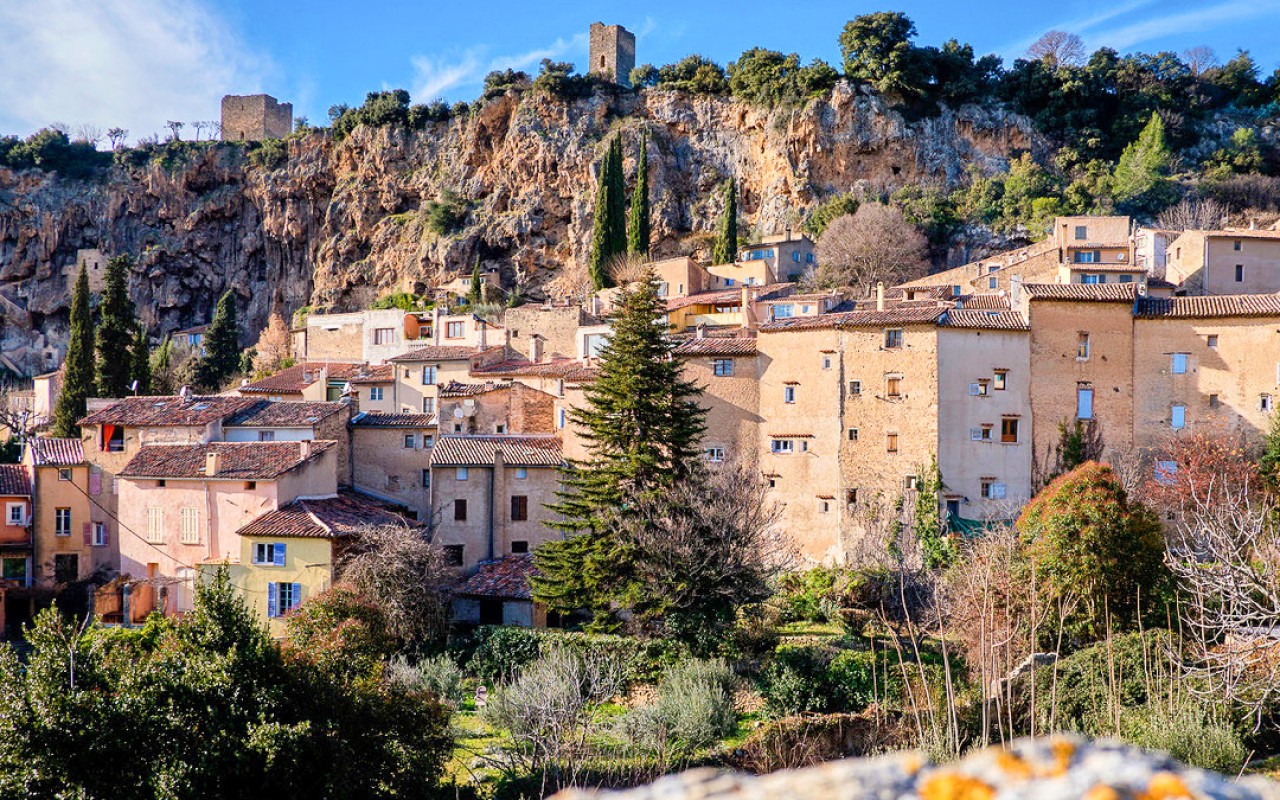
Cotignac is a village in the Provence verte set against an eighty-metre cliff of tufa, riddled with caves and cave dwellings and crowned by two towers. Its main square, shaded by plane trees, holds a market on Tuesday mornings, and the surrounding hills carry well-regarded wine estates. This is inland Var at its best.
The cliff
It is the first thing you see, and it resembles no other Provençal village. Cotignac is built at the foot of a wall of tufa, the porous limestone laid down by an ancient waterfall, eighty metres high and four hundred wide. The rock is riddled with natural cavities that the inhabitants adapted over the centuries: granaries, sheepfolds, refuges, dwellings, cut stairways, a whole vertical village above the village.
You can climb into the cave dwellings by a stairway from the centre and work through several levels of galleries and rooms hollowed out of the stone. At the top, the remains of two medieval towers are a reminder that the cliff also served as a fortress. The view carries over the rooftops and the hills.
The village
Below, everything revolves around the cours Gambetta, a long square lined with century-old plane trees, fountains and terraces. It is one of the finest squares in Provence at village scale, and you will happily spend an hour there doing nothing.
Around it, narrow lanes, tall houses with ochre façades, the sixteenth-century church of Saint-Pierre, an open-air theatre and an olive mill. The Tuesday morning market is among the best regarded in inland Var, and the village fills without becoming unbearable.
The shrines
Cotignac is also a place of pilgrimage, which explains part of its activity. Notre-Dame de Grâces, on a hill just outside the village, is the shrine where Anne of Austria came in 1638 to pray for the birth of Louis XIV, and where John Paul II came in 1984. The place is quiet, the view fine, and people come as much for one as for the other.
The monastery of Saint-Joseph du Bessillon, a little further on, is the only shrine in the world dedicated to an apparition of Saint Joseph, in 1660.
The wines
Cotignac lies within the Côtes de Provence appellation, and the estates in the surrounding hills are among the most interesting in inland Var, where altitude and cool nights produce wines with more tension than those on the coast. Several cellars are open all year, a few minutes from the village.
Nearby
Cotignac sits at the centre of the Provence verte, and makes a good base for a day: Le Thoronet Abbey thirty minutes away, the lake of Carcès, the Sillans waterfall, Entrecasteaux and its château. This is a Var without the sea, wooded and agricultural, where prices and crowds bear no relation to the coast.
Practical information
Where
Cotignac, Provence verte, central Var. Free car parks on the edge of the village
Getting there
1 hr from Puget-sur-Argens · 1 hr 10 from Fréjus · 40 min from Draguignan
How long
2 hrs for the village and the cliff · a full day with the shrines and a wine estate
Cave dwellings
Reached by a stairway from the centre, several levels, closed shoes
Market
Tuesday morning, cours Gambetta
Shrines
Notre-Dame de Grâces and Saint-Joseph du Bessillon, free access
Children
The cave dwellings delight them · steps and drops, hold on to the youngest
Best season
April to June and September-October · the square is shaded even in summer
Frequently asked questions
Yes, a stairway from the village centre gives access to several levels of galleries and rooms hollowed out of the tufa cliff, with the remains of two towers at the top.
This guide is part of the address book of a private estate in Puget-sur-Argens, 60 minutes away, available for weddings and family stays. It is not open to visitors.