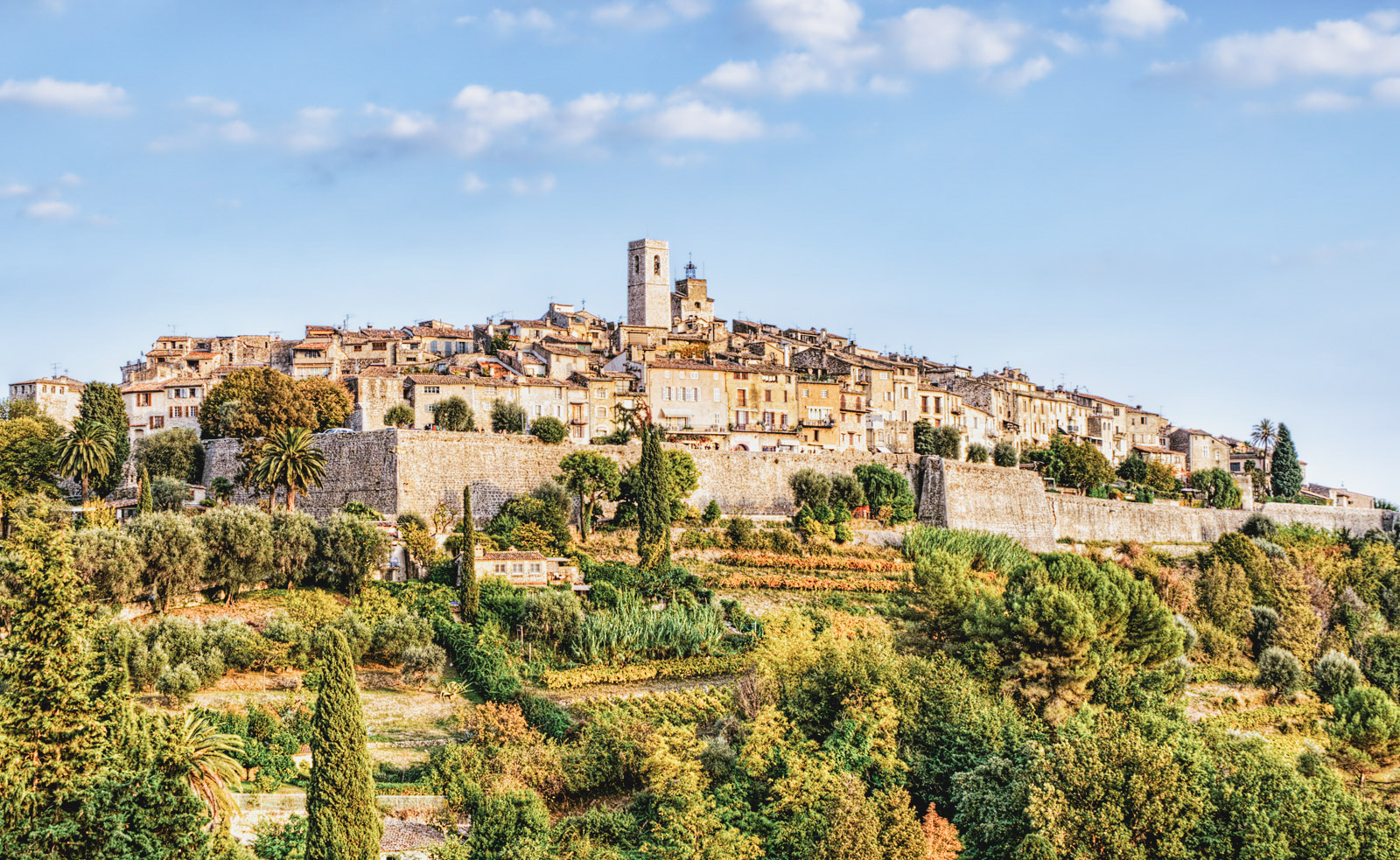
Saint-Paul-de-Vence is a sixteenth-century fortified village between Nice and Vence, famous for its ramparts, its galleries and the cemetery where Marc Chagall is buried. Just above it, the Fondation Maeght, opened in 1964, holds one of the finest modern art collections in Europe, with its Giacometti courtyard and Miró labyrinth in the open air.
The village
A single main street, the rue Grande, running from one gate to the other between sixteenth-century stone houses, and a rampart walk round the walls with views over the hills and the sea beyond. It is small, it is beautiful, and it is saturated.
It has to be said plainly: Saint-Paul-de-Vence is one of the most visited sites in France, and at peak times the rue Grande is walked at a shuffle. The remedy is simple and it works: come before ten or after five. The village then recovers what drew Signac, Modigliani, Soutine and Chagall here in the 1920s, when they paid their bills at the Colombe d'Or with paintings that now hang on the restaurant's walls.
Chagall lived in Saint-Paul for twenty years and is buried there, in the small cemetery at the far end of the village, where the view is superb. His grave is plain, often covered with pebbles left by visitors.
Galleries occupy almost every ground floor. Quality is uneven, but a few are serious.
The Fondation Maeght
This is the real reason to come, and many visitors to the village never walk up to it.
Aimé and Marguerite Maeght, Paris gallerists, had it built in 1964 on the Gardettes hill, a place conceived with artists rather than for them. The Catalan architect Josep Lluís Sert designed a low building of brick and white concrete, open to the pine wood, where inside and outside answer each other.
The result is unique in Europe. The Giacometti courtyard, open to the sky, where *Walking Man* and the tall thin figures stand on the paving. The Miró labyrinth, a terraced garden populated with the artist's ceramics, sculptures and fountains. A chapel with stained glass by Braque. A wall mosaic by Chagall, a pool by Bury, Calder mobiles among the pines. And inside, a permanent collection and temporary exhibitions of the first rank.
Allow two hours, more if the weather is good, since half the interest is outdoors. The foundation is private, charged, and open every day.
The order of the day
The foundation first thing, when the gardens are cool and empty. Lunch down below. The village late in the afternoon, once the coaches have gone. And if you have time, Vence five minutes away, less pretty but far more alive, with the Chapelle du Rosaire decorated by Matisse, which he considered his masterpiece: open only a few hours a day, so check before setting out.
Practical information
Where
Saint-Paul-de-Vence, Alpes-Maritimes, between Nice and Vence. Paid car parks below the village
Getting there
1 hr from Puget-sur-Argens via the A8 · 1 hr 05 from Fréjus · 25 min from Nice
How long
1 hr for the village · 2 hrs for the foundation · a full day with Vence
Fondation Maeght
Open daily, charged, 2 hrs to visit, much of it outdoors
Village
Free access, rue Grande and rampart walk
Chagall's grave
Cemetery at the far end of the village, free access
Matisse chapel in Vence
Very restricted hours, essential to check
Children
The Miró labyrinth holds them · the village is steep and crowded
Best season
April-May and October · before 10am or after 5pm in season
Frequently asked questions
The rue Grande and the rampart walk, the cemetery where Marc Chagall is buried, the art galleries, and above all the Fondation Maeght on the hill just above.
This guide is part of the address book of a private estate in Puget-sur-Argens, 60 minutes away, available for weddings and family stays. It is not open to visitors.