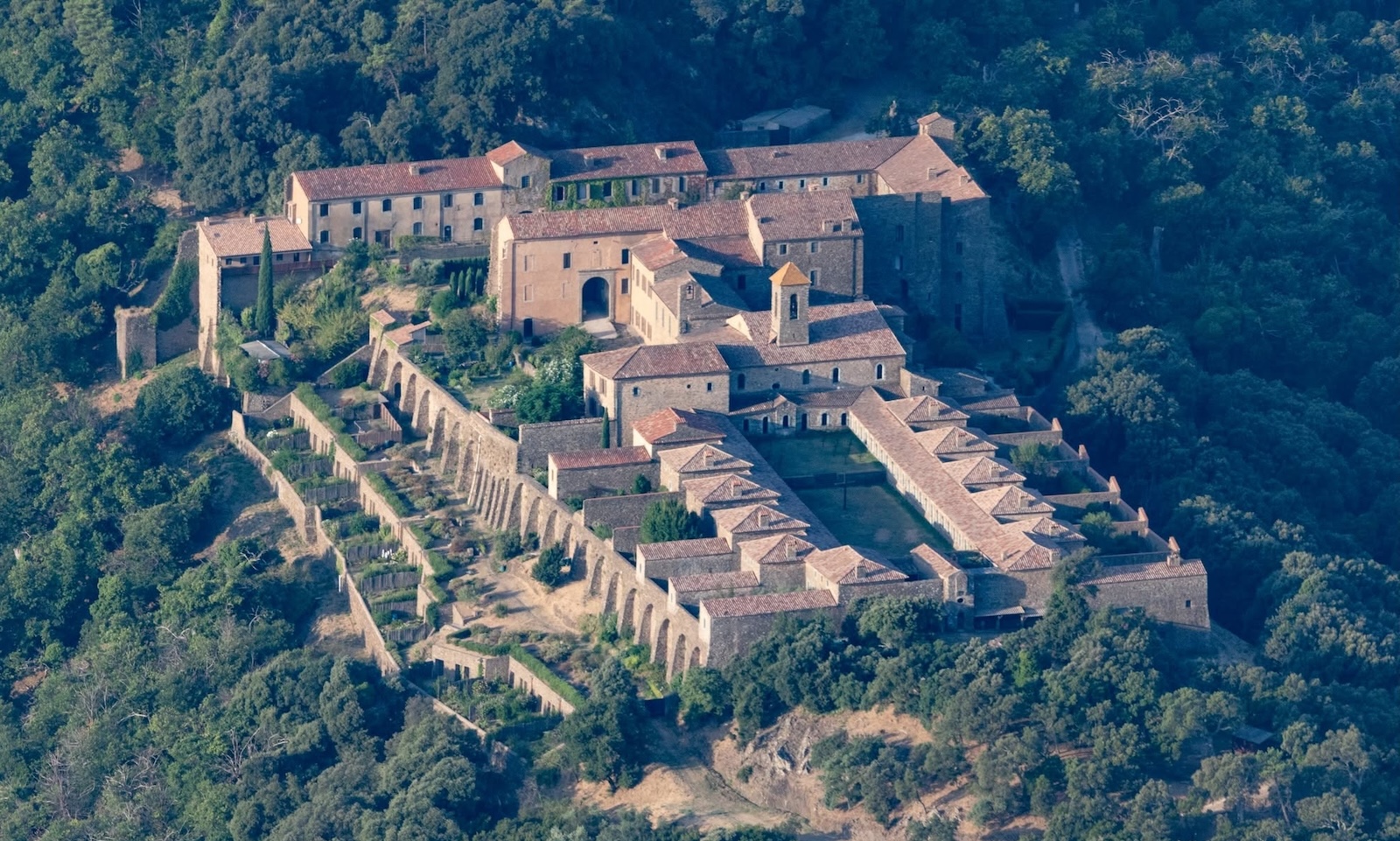
The Chartreuse de la Verne is a monastery founded in 1170 in the heart of the Maures hills, some eleven kilometres from Collobrières along a forest track. Built of dark schist and green serpentine, it is occupied by a monastic community. It closes on Tuesdays and on days of fire risk: check before you set off.
The end of the world
First you have to accept the journey. The charterhouse is eleven kilometres from Collobrières, at the end of a narrow, winding forest road through the chestnut and cork oak woods of the Maures. Allow twenty-five minutes from the village, at thirty kilometres an hour, without meeting anyone.
It was that isolation that decided the Carthusians. The order required a desert, and the Verne valley, with no village and no road, provided one. Founded in 1170 by the bishops of Toulon and Fréjus, the monastery was destroyed, burned and rebuilt several times, abandoned at the Revolution, left in ruins for two centuries, then restored from 1968. Since 1983 a community of the Sisters of Bethlehem has lived here in silence.
Schist and serpentine
This is what strikes you on arrival. The charterhouse is built from the two stones of the massif: schist, dark grey verging on black, for the walls, and serpentine, a bottle-green rock that polishes like marble, for the surrounds, doorways and columns. The contrast between the two, within the austere architecture of a Carthusian house, produces an effect you will see nowhere else.
The complex is large: two cloisters, a Romanesque church, the reconstructed cell of a Carthusian father with its enclosed garden, the refectory, the granaries, a mill. Walking through it you understand the rule of the order: each monk lived alone in his cell, coming together only for the office and one weekly meal.
Allow an hour to visit unaccompanied, an hour and a half taking your time.
The rules to respect
The community lives on site and the visit covers only part of the monastery. Silence is asked for, along with appropriate dress, and no photographing of the sisters. It is no great burden, and it is what makes the place so particular: you are visiting an inhabited monument, not a ruin.
The charterhouse is closed on Tuesdays, as well as in January and on certain religious feast days. And above all, access closes on days of high fire risk, which happens often in July and August: the Maures is among the most sensitive massifs in France and the track can be barred. A phone call or a look at the website before setting off will save you fifty kilometres for nothing.
Collobrières
The village at the start of the track deserves a stop. Capital of the chestnut and of cork, it has its confectioners, its marrons glacés, its chestnut cream, and a chestnut festival on the last three Sundays of October. That is the best time of year to come: the forest is russet, the charterhouse is open, and the fire risk has passed.
Practical information
Where
Chartreuse de la Verne, 11 km from Collobrières by the forest road, Maures massif
Getting there
1 hr 15 from Puget-sur-Argens to Collobrières, then 25 min of track · 1 hr 25 from Fréjus
How long
1 hr to 1 hr 30 unaccompanied
Closures
Tuesdays, January and certain religious feast days
Fire risk
Access closed on days of high risk, frequent in July and August: essential to check before setting off
Price
Charged, unaccompanied visit
On site
Silence requested, appropriate dress, no photographs of the sisters
Road
Narrow and winding, not advised for large vehicles
Children
Possible, but the place asks for quiet
Best season
April to June and October · the chestnut festival at Collobrières in October
Frequently asked questions
Yes, part of the monastery is open to unaccompanied visits, the rest being occupied by a religious community. Allow an hour to an hour and a half.
This guide is part of the address book of a private estate in Puget-sur-Argens, 75 minutes away, available for weddings and family stays. It is not open to visitors.